The post after this one on “black rust” describes why you should heat the pan before applying oil for seasoning. This helps the seasoning to adhere and makes the pan pleasantly black.
http://sherylcanter.com/wordpress/2010/02/black-rust-and-cast-iron-seasoning/
In a previous post, I illustrated how I cleaned and reseasoned an antique cast iron popover pan. This was my first attempt, and my seasoning technique was somewhat haphazard because I couldn’t find consistent, science-based advice. I used a combination of organic avocado oil and strained drippings from organic bacon. This worked pretty well on the popover pan, which doesn’t have a polished surface. But the smooth inner surface of a skillet showed an unevenness of color and texture, and the seasoning wasn’t hard enough. It was too easily marred by cooking utensils or scraping against oven racks.
I wanted to understand the chemistry behind seasoning so I’d know how to fix this, but there is nothing that addresses this issue directly. A Web page on cast iron posted by someone similarly obsessed with the science gave me two crucial clues, the phrases “polymerized fat” and “drying oil”. From there I was able to find the relevant scientific literature and put the pieces together.
The pictures below are both of the same antique cast iron skillet. The “before” close-up on the left is from a picture of the skillet in my previous blog post on making German Pancakes. I stripped the pan with oven cleaner and reseasoned it based on my new understanding. The “after” close-up on the right shows the result.
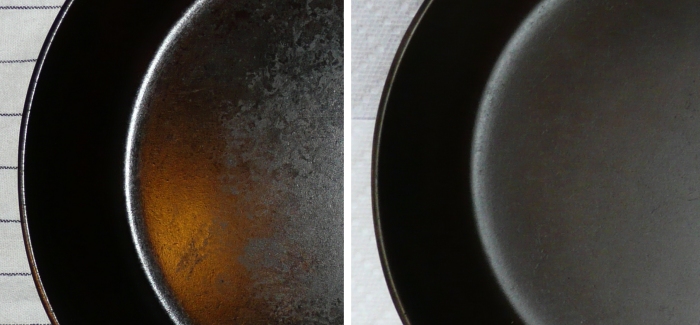
Start With the Right Oil (It’s Not What You Think)
I’ve read dozens of Web pages on how to season cast iron, and there is no consensus in the advice. Some say vegetable oils leave a sticky surface and to only use lard. Some say animal fat gives a surface that is too soft and to only use vegetable oils. Some say corn oil is the only fat to use, or Crisco, or olive oil. Some recommend bacon drippings since lard is no longer readily available. Some say you must use a saturated fat – that is, a fat that is solid at room temperature, whether it’s animal or vegetable (palm oil, coconut oil, Crisco, lard). Some say never use butter. Some say butter is fine. Some swear by Pam (spray-on canola oil with additives). Some say the additives in Pam leave a residue at high temperatures and pure canola oil is best. Some say it doesn’t matter what oil you use.
They are all wrong. It does matter what oil you use, and the oil that gives the best results is not in this list. So what is it? Here are some hints: What oil do artists mix with pigment for a high quality oil paint that dries hard and glassy on the canvas? What oil is commonly used by woodturners to give their sculptures a protective, soft-sheen finish? It’s the same oil. Now what is the food-grade equivalent of this oil?
The oil used by artists and woodturners is linseed oil. The food-grade equivalent is called flaxseed oil. This oil is ideal for seasoning cast iron for the same reason it’s an ideal base for oil paint and wood finishes. It’s a “drying oil”, which means it can transform into a hard, tough film. This doesn’t happen through “drying” in the sense of losing moisture through evaporation. The term is actually a misnomer. The transformation is through a chemical process called “polymerization”.
The seasoning on cast iron is formed by fat polymerization, fat polymerization is maximized with a drying oil, and flaxseed oil is the only drying oil that’s edible. From that I deduced that flaxseed oil would be the ideal oil for seasoning cast iron.
As a reality check of this theory, I googled “season cast iron with flaxseed oil” to see what came up. The very first hit is a page written by a guy who seasons his cast iron cookware with linseed oil from the hardware store because it gives the hardest surface of anything he’s tried. (I’m not sure how safe that is; I don’t recommend it.) Below that were several sites selling traditional cast iron cookware from China, which they advertise as being “preseasoned with high quality flax oil”. I don’t know whether they really use food-grade flaxseed oil (which is expensive) or linseed oil from a hardware store. What’s significant is the claim. Seasoning with high quality flaxseed oil is something to brag about.
With this encouragement, I stripped one of my skillets and reseasoned it with flaxseed oil. As you can see in the picture above, the result was a dramatic improvement. The finish is smooth, hard, and evenly colored.
Seasoning Is Not Cooking: Different Principles Apply
The first time I seasoned a pan I chose avocado oil because it’s monounsaturated and doesn’t easily go rancid. It also has the highest smoke point of any edible oil, 520°F, so I could heat it in a 450°F oven without passing the smoke point. I knew that when cooking, you should never heat an oil past its smoke point because that causes the release of “free radicals”, which are carcinogenic. I was careful not to choose a polyunsaturated oil – and especially not an oil high in omega-3 fatty acids – because these are especially vulnerable to breakdown with heat and the release of free radicals.
Ironically, it’s for exactly these reasons that the best oil for seasoning cast iron is an oil high in omega-3 fatty acids – in particular, alpha-linolenic acid (ALA). Free radicals are actually what enable the polymerization. Drying oils, which produce the hardest polymers, are characterized by high levels of polyunsaturated fatty acids, especially the omega-3 fatty acid ALA.
The lard that was traditionally used for seasoning 100 years ago was much higher in ALA than fat from pigs today, because back then pigs ate their natural diet. Today they are raised on industrial feedlots and forced to eat grain, making their fat low in omega-3s.
Since lard is traditional but no longer readily available, many people substitute bacon drippings, but this is a bad idea. If it’s conventional bacon, you’re baking in carcinogenic nitrates. But even organic bacon is not good for an initial seasoning because it’s filled with salt.
The reason that Pam seems to work well in seasoning is that its main ingredient is canola oil, which is relatively high in ALA (10%), making it a “semi-drying oil”. Flaxseed oil, a drying oil, is 57% ALA. But it’s not a good idea to use a spray oil, no matter what oil it’s made with, because of its additives. You’re doing chemistry here. If you want good results, use pure ingredients.
Fat polymerization can be triggered or accelerated in a variety of ways. As best I can tell from my reading, the cast iron seasoning process is an example of “radical polymerization”. The process is initiated when something causes the release of free radicals in the oil. The free radicals then “crosslink” to form the tough, hard film you see in a well-seasoned pan.
So what is the “something” that initiates the release of free radicals in fat? Iron, for one thing. High heat, light, and oxygen, for some others. To prevent cooking oils from going rancid – i.e., breaking down and releasing free radicals – you need to store them in dark, tightly sealed containers in a cool location. To initiate or accelerate the release of free radicals, put the oil in contact with bare iron and heat it above its smoke point, which will cause even non-drying oils to release free radicals.
I haven’t defined “free radical” or “crosslink” because that gets into details of chemistry that you don’t need to understand to season a cast iron pan. All you need to know is that the molecular structure of the oil changes and becomes something else, something tough and solid. The process is initiated with the release of free radicals, which then become crosslinked, creating a hard surface.
Free radicals are carcinogenic inside your body, and also a cause of aging. So don’t ever heat oil you’re going to eat above its smoke point. If the oil starts to smoke, toss it out and start again. When you’re seasoning a pan, you’re not cooking food. By the time the seasoned pan comes out of the oven, there are no more free radicals.
The Recipe for Perfect Cast Iron Seasoning
The basic idea is this: Smear a food-grade drying oil onto a cast iron pan, and then bake it above the oil’s smoke point. This will initiate the release of free radicals and polymerization. The more drying the oil, the harder the polymer. So start with the right oil.
Go to your local health food store or organic grocery and buy a bottle of flaxseed oil. It’s sold as an omega-3 supplement and it’s in the refrigeration section because it goes rancid so easily. Check the expiration date to make sure it’s not already rancid. Buy an organic flaxseed oil. You don’t want to burn toxic chemicals into your cookware to leach out forever more. It’s a fairly expensive oil. I paid $17 for a 17 ounce bottle of cold-pressed, unrefined, organic flaxseed oil. As it says on the bottle, shake it before you use it.
Strip your pan down to the iron using the techniques I describe in my popover post. Heat the pan in a 200°F oven to be sure it’s bone dry and to open the pores of the iron a little. Then put it on a paper towel, pour a little flaxseed oil on it (don’t forget to shake the bottle), and rub the oil all over the pan with your hands, making sure to get into every nook and cranny. Your hands and the pan will be nice and oily.
Now rub it all off. Yup – all. All. Rub it off with paper towels or a cotton cloth until it looks like there is nothing left on the surface. There actually is oil left on the surface, it’s just very thin. The pan should look dry, not glistening with oil. Put the pan upside down in a cold oven. Most instructions say to put aluminum foil under it to catch any drips, but if your oil coating is as thin as it should be, there won’t be any drips.
Turn the oven to a baking temperature of 500°F (or as high as your oven goes – mine only goes to 450°F) and let the pan preheat with the oven. When it reaches temperature, set the timer for an hour. After an hour, turn off the oven but do not open the oven door. Let it cool off with the pan inside for two hours, at which point it’s cool enough to handle.
The pan will come out of the oven a little darker, but matte in texture – not the semi-gloss you’re aiming for. It needs more coats. In fact, it needs at least six coats. So again rub on the oil, wipe it off, put it in the cold oven, let it preheat, bake for an hour, and let it cool in the oven for two hours. The picture above was taken after six coats of seasoning. At that point it starts to develop a bit of a sheen and the pan is ready for use.
If you try this, you will be tempted to use a thicker coat of oil to speed up the process. Don’t do it. It just gets you an uneven surface – or worse, baked on drips. Been there, done that. You can’t speed up the process. If you try, you’ll mess up the pan and have to start over.
The reason for the very hot oven is to be sure the temperature is above the oil’s smoke point, and to maximally accelerate the release of free radicals. Unrefined flaxseed oil actually has the lowest smoke point of any oil (see this table). But the higher the temperature the more it will smoke, and that’s good for seasoning (though bad for eating – do not let oils smoke during cooking).
I mentioned earlier there’s a myth floating around that vegetable oils leave a sticky residue. If the pan comes out of the oven sticky, the cause is one of three things:
- You put the oil on too thick.
- Your oven temperature was too low.
- Your baking time was too short.
It’s possible to use a suboptimal oil for seasoning, like Crisco or bacon drippings, and still end up with a usable pan. Many (most) people do this. But the seasoning will be relatively soft, not as nonstick, and will tend to wear off. If you want the hardest, slickest seasoning possible, use the right oil: flaxseed oil.
Editorial Note:
Many flax oils contain added ingredients to prevent rancidity, and it’s the tendency of this oil to go rancid that makes it so good for seasoning pans. Flax oil only works if it’s 100% pure flax oil with nothing added, so read the ingredients! People have reported mixed results, and this is probably why.
I have a newer lodge skillet. (2 months old) would it still be necessary to use lye and strip it? Or could I begin the process of seasoning it with flax oil?
Lodge skillets come “preseasoned” with a waxy coating. It makes no sense to season on top of that. If you don’t like the idea of the waxy coating, strip it down. Most people just use it. The quality of the cast iron isn’t as high as antique cast iron such as Griswold. It’s bumpy rather than smooth. You’ll never get the glassy finish.
Hi Sheryl!
Love these articles. I just inherited my dad’s old cast iron- one deep skillet, one shallow, and a large Dutch Oven. I’ve seasoned them with sunflower oil after heavy scrubbing (they were in storage for 10+ years). They came out black and pretty shiny. The next time I reseason them, I’ll definitely try out the flaxseed oil, I already know where it is in the supermarket!
Hi BC. I expect that sunflower oil is also very good for seasoning because, like flaxseed oil, it’s very high in polyunsaturated fatty acids and goes rancid (the “seasoning” effect) at relatively low temperatures. You can’t safely use sunflower oil in cooking. That makes it a good seasoning oil.
That’s great! I haven’t actually used the pots yet, though. I’m actually tempted to just burn the seasoning I have on there and restart with a flaxseed seasoning.
Do you have any recommendations on what kind of spatulas to use with cast iron? Some say to use steel to even everything out, but others say to use plastic so as to not scratch the seasoning.
I use plastic (or silicone or wood) so as not to scratch off the seasoning. I tried the metal spatula advice, and I had to reseason the pan.
great article – glad to see people seriously interested in seasoning rather than blindly following whatever traditional advice. I’ve always been most bothered by instructions to season by filling the pan with oil
just to clarify a couple of things: lye is caustic but non toxic; it’s not the fact it washes off easily, but that the components of ionic compounds can generally be considered independently (eg a solution of NaCl and KI is identical to a solution of KCl and NaI). lye – NaOH – comprises the sodium you find in table salt and the hydroxide found in (the small dissociated proportion of) water. second, the problem with hardware store linseed oil isn’t that it’s unrefined, but that it contains “dryers” … metallic salts that speed up polymerization at room temperature. this oil is often, misleadingly, called “boiled” linseed oil. this is easily confused with “stand oil” – linseed oil that has been held at high temperature in oxygen free conditions. stand oil is used by artists and in high-end violin varnish etc. because it not only dries quickly but also gives the toughest outcome of the linseed products; and since it doesn’t contain dryers it could very possibly be safe and effective for seasoning (i’ll leave it to others to do that research)
couple of other thoughts: (a) tung oil is apparently tougher than linseed oil as a wood finish. i believe candle nuts are very closely related to tung, so next time i season a pan i’ll probably rub one of these very oily nuts against the hot surface. (b) I once poured a sizeable layer of oil in a pan and heated it for ages just for the heck of it, and i got a very (~1/8 inch) thick layer that was very hard and slippery and didn’t have any tendency to chip off (can’t remember which oil i used). (c) in addition to polymerization, it seems to me an important aspect of seasoning is that any components that can’t cope with the heat will vaporize off, giving a process of survival of the fittest (= most polymerized). (d) the reason i don’t like cleaning a seasoned pan with detergent is that i like to leave a slightly greasy surface after cleaning so i can dry the pan off on the stovetop and slightly re-season it
What a great article. I’ve got a couple of oldish cast iron pans with patchy/sticky seasoning, so I’m going to give stripping and re-seasoning with flaxseed oil a try.
Upthread, someone asked about using this method to season carbon steel pans, but nobody seems to have answered. I’m no chemist, and I’ve got a CS paella pan that needs seasoning before I use it. Any idea as to whether this technique will work for me?
Anyone want that glossy finish and not smoke up your house?
This is how I did it. You can use whatever oils you want.(Flax, sunflower, soy, canola…)
1. I used canola and wiped it on thin
2. Then you want to dry the oil by cooking below the smoke temperature at first. Canola smokes pretty hot at about 475F, so bake your pan at 350F for 1.5 – 2 hours, it will not all disappear in the form of smoke. Instead it will be slightly tacky.
3. This is where you follow the high heat advice and crank the temperature beyond the smoke point of the oil you’re using 475F-500F for canola for 1 hour. That bakes the dried oil on the pan and really does feel like smooth enamel and will no longer be tacky.
4. So it’s a combination of peoples advice that is the actual way to season a pan. Found out from experimentation. This also saves money on oil because it doesn’t all turn to smoke. Even when I baked on the tacky oil past smoke point at 500F it wasn’t that smokey in here. Didn’t even use my fan. Cool and repeat
Good luck
First of all, I am far from scientifically minded. Most of what you discuss is over my head, I just don’t analyze the same way you can 😉
I’m in the massage therapy business so when I saw that you have used avocado oil, I was intrigued. Brought a bottle home from the warehouse today, because I have been stripping off the pre-seasoning of a 12″ Lodge. Was hoping to smooth it out a bit, but reading the comments discussing that it will always be a rough surface I am a little disappointed. 🙁 One thing that was driving me absolutely batty was the rust. I left the skillet inside a bag after spraying the heck out of it with Easy Off the day before. Obviously it was slimy with gunk when I took it out. Tried to rinse it well in the sink, and used a 0000 steel wool to try and get any last black bits off. No sooner did I try and dry it than it would rust over. I tried and tried to get it off, wipe it down, wrecked some bar towels, shredded paper towels. Eventually tried to subdue the rust with a swipe of vinegar/water solution, which held it off a little, so i put it in my oven that was at 250 degrees to dry out. Took it out and swiped it with a thin layer of avocado. Looked fantastic right there, popped it back in and cracked the heat to 500, left it there for about 45 minutes.
Of course the entire time I was second guessing the steps I took. Should I have used anti-bacterial soap when rinsing off the oven cleaner? Should I have not bothered with the steel wool at all, which did get a little wet in the process? Should I just have done what other people have done with theirs – build a campfire and toss it on the coals?
Please let me know if you think I made any grievous errors. Right now the pan is still cooling slowly in the oven (second floor apartment, it’s so hot already I can’t leave the oven open a crack to cool faster).
Thanks so much for your blog, I am hoping to make the popovers someday when the Fat Man in the Red Suit brings me something to make them in 🙂
Sheryl,
Have you ever seasoned a stainless steel pan with a similar process? Right now my eggs stick like crazy and I am thinking of using this process to help.
Steve – you cannot season stainless steel the way you can cast iron. It’s a completely different thing. There are techniques for cooking with stainless steel to prevent sticking. I can’t tell you what they are because I never liked it either and chose cast iron instead.
Sheryl – Thank you for the reply! I am still considering seasoning for an egg pan I use because my grandfather swore by his seasoned egg pans. I was never able to get the entire process out of him, and not sure he even remembered the details. But I’ve used the pans and they are great! I’ll let you know how it goes if you are interested. Also, thanks for the great article!
Sheryl this is fascinating and the best information I have ever sourced on seasoning cast iron. I now have my bottle of New Zealand organic cold pressed Flax seed oil and ready to start! And yes it was in the refrigerated section in the store!
I am a cast iron Camp Oven collector and cook in Queensland Australia.
Your dedication is really appreciated.
Since hemp seed oil is a drying oil, which used to be used in the manufacture of paints, would it be good to use to season cast iron as well? I have a lot of Griswold cast iron pans that I could try this on.
Sheryl, Thanks soooo much for all your work and expierments here. I love cast iron and have been trying your methods for the past couple of weeks. I seasoned my pan with the flaxssed oil as mentioned, and everything came out looking good. Used it a couple of times and worked great. Then I was making a recipie that called for italian dressing. After finishing dinner and looking at the pan, it looked as if all the “seasoning” had been washed away???? Was this do to the vinager in the dressing??? I have also boiled water in the pan for making other dishes and it seems the “seasoning” gets washed away again. Are there things you should not cook in a seasoned cast iron pan that will ruin, or deteriorate a well seasoned pan?? Would love to hear your thoughts.
Thanks!!!
Hi Ted. You did manage to find the two great no-nos of cast iron cooking: boiling water and cooking acid-based foods (like tomato sauce or anything with a lot of vinegar). Both can actually damage the iron, as well as the seasoning. People soak in vinegar to remove rust, but if you do it too long you can destroy the pan (see my popover post).
I use a ceramic pot when I need to boil water or cook something highly acidic.
Sheryl, what would your second recommendation be for a good oil if I’m not going to use flaxseed oil? Canola or soybean, or something else?
Thanks.
WOW! There are some fantastic tips and tricks here. Thanks both to Sheryl and everyone else for posting! Seasoning cast iron cookware seems to me akin to fishing; everyone has a different technique but none of them work for me. I have a dutch oven and a double sided griddle that I have “seasoned” with Crisco by various methods. It began with seasoning in the oven but my wife ran me out of the kitchen after I smoked up the house. Next, I moved my operation outside to the grill but my seasoning came out splotchy with some tacky spots. I was convinced that it was because I couldn’t keep the coals going long enough to finish the seasoning process. The only logical thing to do in my mind was to do the same thing over a campfire. I heated my cast iron and took a rag full of Crisco and wiped all surfaces repeatedly. The Crisco immediately smoked because I was putting it on a surface that was already screaming hot. After letting it cool, it seemed to be seasoned pretty well so I tried to cook in it but it seemed like the seasoning broke down a little and wasn’t smooth and uniform. I was pretty frustrated and discouraged that I would never get the smooth, seemingly indestructible surface that my grandmother’s cast iron cookware had. I chalked it up to repeated use and I figured that I would eventually have a good seasoning. Flash forward to this last weekend. I was grilling some food and on one side of my grill I had my griddle heating to cook some bacon on the flat side and my dutch oven heating up empty next to it. After all, this was the kind of use that provides the seasoning I was looking for, right? After the bacon was cooked, I took the grease from the griddle and smeared the dutch oven down with it. I wiped both pieces down until they were lightly coated and turned both upside down to prevent any pooling. I let them both sit over the hot coals for about 2 hours until the coals went out and the pieces cooled enough to touch. I rinsed them under hot water and wiped them out. The first thing I noticed was that the griddle had a line across it where the seasoning was worn off but the dutch oven had a very metallic looking glaze all over it that doesn’t wipe off. The inside looks great but the outside has patched of carbon(?) and a light rust spot on the bottom. Can anyone explian what happened to these pieces? Do I have to totally strip and reseason both of them? I am hoping that I can just hit these spots with a little steel wool to sooth them / knock the rust out and try the flaxseed oil method that Sheryl outlines. I want the seasoning like the pictures she has above! Also, I do cook over campfires / grills quite a bit so I need everything to be able to handle heat very well. Thanks for reading…any advice is welcomed.
Thanks for a very interesting post. The one thing that it left me curious about at the end is – what is the polymer created, and is it as OK for health as the oil it is created with? I will do some further reading. 🙂
Hey, great guide, glad to see someone giving a thorough explanation about the whole thing. My pan is currently baking through its 3rd coat, and the first two have gone great. I plan to make a youtube video once it’s all done showing the results and directing people here to give due credit! I’m wondering how you think soap will affect this coating. I’d have to imagine it wouldn’t hurt – in fact, I doubt you’d be able to get this coat off with anything but the cleaning methods you mentioned in the other post. Still, wondering what you think. Thanks again.
http://sherylcanter.com/wordpress/2010/02/black-rust-and-cast-iron-seasoning/#comment-496
I had stopped using my iron skillets, hanging them on the wall for decoration, due to unusual iron levels in my blood. I am assuming if the skillet is polymerized as you describe if it would be less likely to leach iron into the food? Any comments appreciate. thanks
A properly seasoned skillet doesn’t leach a lot of iron into the food. When a cast iron skillet is unseasoned, you can see the iron when you wipe it with a paper towel. When it’s seasoned, the paper towel wipes clean.
Do you know where (online) could one purchase a good quality, bare (not pre-seasoned) cast iron pan? Even the names of some of the brands that manufacture them would be helpful.
Thanks
The only “bare” (not pre-seasoned) cast iron pans you can buy are the antique ones. All new pans are pre-seasoned. I buy my cast iron pans on eBay. I like Griswold.
Thank you for the information. Interestingly, I’ve read on various pages over the internet that cast iron pans don’t like acidic foods like vinegar, tomatoes etc. as they damage the seasoning. Is the polymer resulting from the drying of flaxseed oil not chemically resistant to acids?
I don’t have a cast iron pan to experiment as I’m only just discovering cast iron cookware and this point makes me question the versatility of cast iron. I would certainly like to hear your take on this.
Thanks
A further question relating to my first post, if I may. How does the flaxseed oil seasoning you describe in your article compare with a newly purchased pre-seasoned pan?
Hello there.
Thanks for this article. I have a large batch of flaxseed oil that has gone rancid (I bought it for the first time and wasn’t aware that it had to be refrigerated). As I can read here I can still use it for my iron pans since chemically, the seasoning process is the same process as “going rancid” – the release of free radicals. I’ll try that process as it is described above.
But since I have a lot of this rancid flaxseed oil and not so many pans to season, I was wondering if anyone knows whether rancid flaxseed has any other practical uses, since it is no longer edible. I know linseed oil for wood and paint is from flaxseed oil, but it has been through a different process than the edible kind of oil?? Can I use my rancid flaxseed oil as a wood finish?? Or in the oil paint I use for art?? And are there any other uses?? I feel it’s a shame to throw it out if it has some practical uses around the house. I would really appreciate anyone’s knowledge on this issue. Thanks 🙂
Oh, and one more question. Can I store this rancid flaxseed oil outside of the fridge, if I only use it for non-edible practical purposes. Or should I store it in the fridge so it doesn’t get “too” rancid. I wouldn’t know if it can get “too rancid” for these purposes. Hope someone can educate me about this 🙂 – Liz
Thanks for the info. For day to day cooking, not seasoning, what oil have you found that works the best? I am trying to find an oil that is low in saturated fat and does not stick.
Thanks
Hamilton
Very Insightful! Have you looked into Hempseed oil? I’m curious what you think. Its Omega’s are very high.
I’ve been following the instructions in this post, but after 6 cycles my pan is a deep brown instead of black. Is that ok, or is something going wrong?
That’s fine. Did you do this first? (This link is at the top of the post):
http://sherylcanter.com/wordpress/2010/02/black-rust-and-cast-iron-seasoning/
When you do this, it turns more black than brown.
used rendered horse fat to session a dutch oven and it has turned a onyx black and as to the hardness it is like a diamond nothing scratches it under normal wear but to get the finish i had to sand it with 1200 wet and dry sand paper
Thank you Sheryl for the equally insightful response!
I just wanted to say thanks for the cornucopia of information on your site that I’ve stumbled across. I just bought a cast-iron skillet today (from the Emeril Lagasse line of cookware) and I was looking around at various sites to make sure I seasoned it correctly.
Your articles seem to cover everything quite well so I’ll obtain some flaxseed oil tomorrow and start the process of curing.
I’m a Research Engineer and I appreciate your scientific analysis and thanks for sharing. It would be interesting to test the Mohs Hardness of carbon polymer layer formed by all these oils. If the Hardness of Flax oil and soy oil are close then we can use inexpensive soy oil. I bough a lodge logic skillet ad a griddle pan and still debating which oil is better Flax or Soy. After digging I found that Lodge uses proprietary soy oil for pre-seasoning.
Great info, thank you!
What are your thoughts on Flax oil labeled “high lignan” or oils with added antioxidants?
No thoughts on that – haven’t researched it. (Sorry about the spammer. I’ve deleted about a dozen comments from that jerk – missed that last one.)
Do you think that the antioxidants could inhibit the drying?
Theoretically, yes, it makes sense that antioxidants would interfere with seasoning, now that I think about it, since oxidation is part of both black rust and polymerization – both of which you want when seasoning cast iron. I haven’t tried it, though.
I am attempting to season my first cast iron pan (brand new uncured) and was wondering: is it necessary to bake the oil above its smoke point to achieve a desirable finish?
Already having baked my pan once, I was left with an unsatisfactory brown and sticky finish. I used a Non-Hydrogenated All Vegetable Shortening (the only ingredient being Mechanically Pressed Organic Palm Oil). The smoke point for palm oil is 450 and I baked my pan at 350 for one hour, so I thought that might be the problem. Thoughts?
Thanks for the article.
My thought would be that you didn’t read her suggestions
Sheryl, thanks so much for the information! I am on my last coat before I try re-using my pan after your method. After completely reading this page, I was disappointed to find the comments on the Lodge, specifically related to the rough surface as opposed to the glassy/smooth one that I so desire. (for the record, this is my first foray into cast iron cooking and I didn’t know anything about the surface). With that, do you know or think I should still get a relatively non-stick experience? If not, I am certainly willing to go gor a different kind and certainly would entertain the Griswold ones. If I do go that route… any suggestions as to what to look for or avoid on eBay? do you think your stripping method should pretty much guarantee that any pan should be fine? Thanks again for your effort with this page.
I have baked on a few coats of flax oil and am left with a nice semi-matte surface that feels very slick to the touch, or when wiping with a dry paper towel. Still though, when I try to cook eggs, I will preheat the pan, add a bit of fat (I’ve tried bacon grease, olive oil, ghee, coconut oil), I’ve even tried a sprinkle of salt also… they stick like crazy.
You probably need more coats. After a while it starts to develop a sheen and then things stop sticking, though you still need some fat. It gets more nonstick with use.
Where or how to get cast iron worth the trouble?
With the work involved, and limited space I want to have a few good pieces of cast iron cookware, but I’m not sure where to get them. I like the simple and no bs nature of cast iron, especially after one guest instantly destroyed two pieces of teflon nonstick while being ‘helpful’. Knife marks clear through to bare aluminum… she would have wrecked a full set if I’d had one!
I don’t like the visibly rough finish on the new pans, even if that is not the most relevant issue. I’ve also read in blogs that the finish is different from the old ones at a small scale – under a microscope – because of either different casting methods, machined vs raw castings (the machining process creates a graphitic layer, as with CGI engine blocks??) and possibly the iron recipe used.
In any case I want cookware that becomes glass-smooth after seasoning, preferably with tight fitting lids. A lid that can lock on (so you can carry it around with less risk) would be even better.
I don’t have a self cleaning oven to conveniently clean old cookware, nor a workshop (stuck in a small apartment w no basement, tho I can hang out on the fire escape).
Should I
get something new, smooth it with sandpaper and then try to wash/brush out the embedded abrasive grit,
hunt for old stuff on eBay and re-season it, or
something else I haven’t thought of?
It just seems Lodge is being lazy by omitting the last step, it would be trivial to do a polishing/machining operation one the line is set up for it. They’re about the only game in town and they know it, and they figure most people don’t know any better. Thus I’m hesitant to give them my money, even though they’re cheaper than locating and shipping the older stuff.
any advice from experience or reliable sources, especially near NYC are appreciated
Shoot, more problems. I spent a good bit of yesterday seasoning my pan. I scrubbed it with a scotchbrite before hand and wiped out with alcohol to start with a nice clean surface. Dried it with heat then began the process. I would coat the pan, then wipe everything off, stick in the oven at 505 for an hour. Then I would take it out, wipe on (and off) another layer, then back in for another hour. I think I got 7 coats on this one pan and it was looking good (sort of a dark reddish color to it). I was also putting just a couple coats on a well seasoned pan, so it spent more time in the oven. Up till the end everything looked good. I shut down the oven when I went to bed and left them in to cool slowly.
When I woke up to look, both pans had what looked like sparkly spots. Upon further inspection, this is the seasoning flaking off. On the well seasoned pan it is really bad, basically all the old seasoning it flaking off in tiny flecks. On the other pan, the new seasoning is doing so to a lessor extent. I don’t understand why… I shot the pan with an ir temp gun a number of times and it was generally around 460
All I can say is, you didn’t do what I described in this article. You baked each layer for a much shorter time than I did, so each layer was not fully polymerized before you put on the next layer. You did one hour; I did three or more – one hour at full heat, then let it cool in the oven as the oven cooled (it’s still baking). Also, I have no idea what affect alcohol has on the whole thing. I didn’t add a layer of alcohol. It could have added a film that prevented the polymerized fat from adhering.