The post after this one on “black rust” describes why you should heat the pan before applying oil for seasoning. This helps the seasoning to adhere and makes the pan pleasantly black.
http://sherylcanter.com/wordpress/2010/02/black-rust-and-cast-iron-seasoning/
In a previous post, I illustrated how I cleaned and reseasoned an antique cast iron popover pan. This was my first attempt, and my seasoning technique was somewhat haphazard because I couldn’t find consistent, science-based advice. I used a combination of organic avocado oil and strained drippings from organic bacon. This worked pretty well on the popover pan, which doesn’t have a polished surface. But the smooth inner surface of a skillet showed an unevenness of color and texture, and the seasoning wasn’t hard enough. It was too easily marred by cooking utensils or scraping against oven racks.
I wanted to understand the chemistry behind seasoning so I’d know how to fix this, but there is nothing that addresses this issue directly. A Web page on cast iron posted by someone similarly obsessed with the science gave me two crucial clues, the phrases “polymerized fat” and “drying oil”. From there I was able to find the relevant scientific literature and put the pieces together.
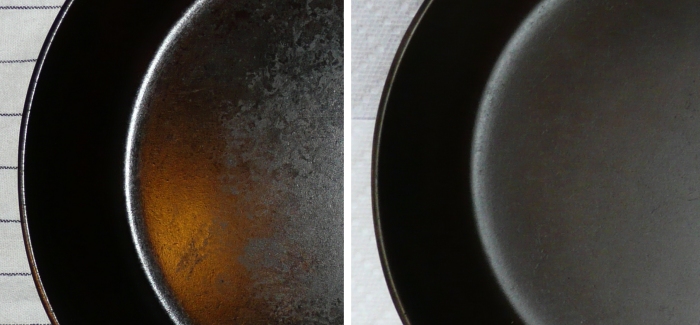
The pictures below are both of the same antique cast iron skillet. The “before” close-up on the left is from a picture of the skillet in my previous blog post on making German Pancakes. I stripped the pan with oven cleaner and reseasoned it based on my new understanding. The “after” close-up on the right shows the result.
Start With the Right Oil (It’s Not What You Think)
I’ve read dozens of Web pages on how to season cast iron, and there is no consensus in the advice. Some say vegetable oils leave a sticky surface and to only use lard. Some say animal fat gives a surface that is too soft and to only use vegetable oils. Some say corn oil is the only fat to use, or Crisco, or olive oil. Some recommend bacon drippings since lard is no longer readily available. Some say you must use a saturated fat – that is, a fat that is solid at room temperature, whether it’s animal or vegetable (palm oil, coconut oil, Crisco, lard). Some say never use butter. Some say butter is fine. Some swear by Pam (spray-on canola oil with additives). Some say the additives in Pam leave a residue at high temperatures and pure canola oil is best. Some say it doesn’t matter what oil you use.
They are all wrong. It does matter what oil you use, and the oil that gives the best results is not in this list. So what is it? Here are some hints: What oil do artists mix with pigment for a high quality oil paint that dries hard and glassy on the canvas? What oil is commonly used by woodturners to give their sculptures a protective, soft-sheen finish? It’s the same oil. Now what is the food-grade equivalent of this oil?
The oil used by artists and woodturners is linseed oil. The food-grade equivalent is called flaxseed oil. This oil is ideal for seasoning cast iron for the same reason it’s an ideal base for oil paint and wood finishes. It’s a “drying oil”, which means it can transform into a hard, tough film. This doesn’t happen through “drying” in the sense of losing moisture through evaporation. The term is actually a misnomer. The transformation is through a chemical process called “polymerization”.
The seasoning on cast iron is formed by fat polymerization, fat polymerization is maximized with a drying oil, and flaxseed oil is the only drying oil that’s edible. From that I deduced that flaxseed oil would be the ideal oil for seasoning cast iron.
As a reality check of this theory, I googled “season cast iron with flaxseed oil” to see what came up. The very first hit is a page written by a guy who seasons his cast iron cookware with linseed oil from the hardware store because it gives the hardest surface of anything he’s tried. (I’m not sure how safe that is; I don’t recommend it.) Below that were several sites selling traditional cast iron cookware from China, which they advertise as being “preseasoned with high quality flax oil”. I don’t know whether they really use food-grade flaxseed oil (which is expensive) or linseed oil from a hardware store. What’s significant is the claim. Seasoning with high quality flaxseed oil is something to brag about.
With this encouragement, I stripped one of my skillets and reseasoned it with flaxseed oil. As you can see in the picture above, the result was a dramatic improvement. The finish is smooth, hard, and evenly colored.
Seasoning Is Not Cooking: Different Principles Apply
The first time I seasoned a pan I chose avocado oil because it’s monounsaturated and doesn’t easily go rancid. It also has the highest smoke point of any edible oil, 520°F, so I could heat it in a 450°F oven without passing the smoke point. I knew that when cooking, you should never heat an oil past its smoke point because that causes the release of “free radicals”, which are carcinogenic. I was careful not to choose a polyunsaturated oil – and especially not an oil high in omega-3 fatty acids – because these are especially vulnerable to breakdown with heat and the release of free radicals.
Ironically, it’s for exactly these reasons that the best oil for seasoning cast iron is an oil high in omega-3 fatty acids – in particular, alpha-linolenic acid (ALA). Free radicals are actually what enable the polymerization. Drying oils, which produce the hardest polymers, are characterized by high levels of polyunsaturated fatty acids, especially the omega-3 fatty acid ALA.
The lard that was traditionally used for seasoning 100 years ago was much higher in ALA than fat from pigs today, because back then pigs ate their natural diet. Today they are raised on industrial feedlots and forced to eat grain, making their fat low in omega-3s.
Since lard is traditional but no longer readily available, many people substitute bacon drippings, but this is a bad idea. If it’s conventional bacon, you’re baking in carcinogenic nitrates. But even organic bacon is not good for an initial seasoning because it’s filled with salt.
The reason that Pam seems to work well in seasoning is that its main ingredient is canola oil, which is relatively high in ALA (10%), making it a “semi-drying oil”. Flaxseed oil, a drying oil, is 57% ALA. But it’s not a good idea to use a spray oil, no matter what oil it’s made with, because of its additives. You’re doing chemistry here. If you want good results, use pure ingredients.
Fat polymerization can be triggered or accelerated in a variety of ways. As best I can tell from my reading, the cast iron seasoning process is an example of “radical polymerization”. The process is initiated when something causes the release of free radicals in the oil. The free radicals then “crosslink” to form the tough, hard film you see in a well-seasoned pan.
So what is the “something” that initiates the release of free radicals in fat? Iron, for one thing. High heat, light, and oxygen, for some others. To prevent cooking oils from going rancid – i.e., breaking down and releasing free radicals – you need to store them in dark, tightly sealed containers in a cool location. To initiate or accelerate the release of free radicals, put the oil in contact with bare iron and heat it above its smoke point, which will cause even non-drying oils to release free radicals.
I haven’t defined “free radical” or “crosslink” because that gets into details of chemistry that you don’t need to understand to season a cast iron pan. All you need to know is that the molecular structure of the oil changes and becomes something else, something tough and solid. The process is initiated with the release of free radicals, which then become crosslinked, creating a hard surface.
Free radicals are carcinogenic inside your body, and also a cause of aging. So don’t ever heat oil you’re going to eat above its smoke point. If the oil starts to smoke, toss it out and start again. When you’re seasoning a pan, you’re not cooking food. By the time the seasoned pan comes out of the oven, there are no more free radicals.
The Recipe for Perfect Cast Iron Seasoning
The basic idea is this: Smear a food-grade drying oil onto a cast iron pan, and then bake it above the oil’s smoke point. This will initiate the release of free radicals and polymerization. The more drying the oil, the harder the polymer. So start with the right oil.
Go to your local health food store or organic grocery and buy a bottle of flaxseed oil. It’s sold as an omega-3 supplement and it’s in the refrigeration section because it goes rancid so easily. Check the expiration date to make sure it’s not already rancid. Buy an organic flaxseed oil. You don’t want to burn toxic chemicals into your cookware to leach out forever more. It’s a fairly expensive oil. I paid $17 for a 17 ounce bottle of cold-pressed, unrefined, organic flaxseed oil. As it says on the bottle, shake it before you use it.
Strip your pan down to the iron using the techniques I describe in my popover post. Heat the pan in a 200°F oven to be sure it’s bone dry and to open the pores of the iron a little. Then put it on a paper towel, pour a little flaxseed oil on it (don’t forget to shake the bottle), and rub the oil all over the pan with your hands, making sure to get into every nook and cranny. Your hands and the pan will be nice and oily.
Now rub it all off. Yup – all. All. Rub it off with paper towels or a cotton cloth until it looks like there is nothing left on the surface. There actually is oil left on the surface, it’s just very thin. The pan should look dry, not glistening with oil. Put the pan upside down in a cold oven. Most instructions say to put aluminum foil under it to catch any drips, but if your oil coating is as thin as it should be, there won’t be any drips.
Turn the oven to a baking temperature of 500°F (or as high as your oven goes – mine only goes to 450°F) and let the pan preheat with the oven. When it reaches temperature, set the timer for an hour. After an hour, turn off the oven but do not open the oven door. Let it cool off with the pan inside for two hours, at which point it’s cool enough to handle.
The pan will come out of the oven a little darker, but matte in texture – not the semi-gloss you’re aiming for. It needs more coats. In fact, it needs at least six coats. So again rub on the oil, wipe it off, put it in the cold oven, let it preheat, bake for an hour, and let it cool in the oven for two hours. The picture above was taken after six coats of seasoning. At that point it starts to develop a bit of a sheen and the pan is ready for use.
If you try this, you will be tempted to use a thicker coat of oil to speed up the process. Don’t do it. It just gets you an uneven surface – or worse, baked on drips. Been there, done that. You can’t speed up the process. If you try, you’ll mess up the pan and have to start over.
The reason for the very hot oven is to be sure the temperature is above the oil’s smoke point, and to maximally accelerate the release of free radicals. Unrefined flaxseed oil actually has the lowest smoke point of any oil (see this table). But the higher the temperature the more it will smoke, and that’s good for seasoning (though bad for eating – do not let oils smoke during cooking).
I mentioned earlier there’s a myth floating around that vegetable oils leave a sticky residue. If the pan comes out of the oven sticky, the cause is one of three things:
- You put the oil on too thick.
- Your oven temperature was too low.
- Your baking time was too short.
It’s possible to use a suboptimal oil for seasoning, like Crisco or bacon drippings, and still end up with a usable pan. Many (most) people do this. But the seasoning will be relatively soft, not as nonstick, and will tend to wear off. If you want the hardest, slickest seasoning possible, use the right oil: flaxseed oil.
Editorial Note:
Many flax oils contain added ingredients to prevent rancidity, and it’s the tendency of this oil to go rancid that makes it so good for seasoning pans. Flax oil only works if it’s 100% pure flax oil with nothing added, so read the ingredients! People have reported mixed results, and this is probably why.
Rubbing alcohol will not leave any type of film, that’s why it is used to clean surfaces in preparation for adhesives. How long the over retains heat is going to vary quite a bit between ovens, but I think it’s safe to say that the pan temp will dip below the point which the oil is undergoing changes long before 3 hours.
The well seasoned pan only got 2 layers over that time, so it did spend about 3 hrs between coats. That is the pan that suffered the most, it lost nearly all of its seasoning.
Sheryl,
Thank you for the advice. I’d like to note that Lodge is not the only company currently selling cast iron cookware. Meijer (At least where I live) sells a brand called Grand Gourmet. I was able to purchase a 10″ skillet for about $14, while an 8″ skillet was only $9 – well worth the money to experiment with. I originally wanted just an 8″ skillet to replace an aging teflon coated egg pan – I thought it’d be much better to avoid using teflon, especially because I eat eggs often. I ended up with both pans.. not sure if either were pre-seasoned as I scrubbed them as soon as I got home and got to putting a good layer of seasoning on them.
My first pan was seasoned haphazardly with peanut oil, and after a few cycles I could cook eggs in it. I picked up the 8″ pan recently, and I’m currently seasoning it to your exact instructions with the exception of using peanut oil instead. I’ll give an update with how well this works. To be honest I can’t remember why I chose peanut oil other than the fact that I haven’t had the chance to pick up flaxseed oil. Worst case scenario, I strip it and re-season it with flaxseed oil.
Just a few random notes, and thanks for the scientific approach! As a student in biology I definitely appreciate it.
After reading you article, I have a question for you. But first, let me thank for an amazing read!
Would you happen to know if this method works for seasoning my blue steel frying pan?
This method is featured on the new 2011 January/February issue of Cooks Illustrated (only available on the website at the moment AFAIK) and credits this article!
Thanks very much for letting me know, Jason!
Jason, I just read the article in Cooks Illustrated. Great independent testing of the method! Here’s the link, for those with a Cooks Illustrated Web subscription (requires payment):
http://www.cooksillustrated.com/howto/detail.asp?docid=26897
I forgot to ask my question in my post above! Sheryl, my seasonings came out glassy, onyx black with the Crisco (many coats), and I have managed to have very little smoke as opposed to when I used the vegetable oil. The surface also seems pretty hard, and is very non-stick. Do you think that going over the vegetable oil added any difference to my particular process?
If I had found this blog sooner, I would have gone with the whole process here, including stripping the Lodge coating, but unfortunately I was too late.
My seasonings look and perform like you can’t get better, but I am curious about your thoughts. I do put a little olive oil or butter before cooking and really do not need a spatula to “scrape” with, only lift/flip.
This is a great site.
I wanted to pass on another way of cleaning and using cast iron.
I have an old gas grill outside, and I have a cast iron skillet that lives inside it. I like to use it to cook steaks, as the heat buildup of the cast iron sears the juices in and cooks faster than using the racks. I have no idea of the identity of the skillet, the terms “NO. 10” and “12 7/16 in.” are cast into the bottom.
I preheat the grill with the pan inside for about 10 min. Then I throw the pre-oiled ½ in. steaks in, turn every 30 sec., and in about 3 min. they are cooked to perfection.
I then leave the pan inside the grill without cleaning. Any residue seems to turn to ash during the cool-down. However, crud gradually builds up, and periodically to clean it out, I do the following.
I get my right-angle grinder with a wire wheel cup head and grind the crud out down to the bare metal. It seems to work very fast, and the wire brush seems to “burnish” the bare metal, reducing the tendency to re-rust, much as it does when I use it in my other metal working construction projects.
I actually have never properly seasoned this pan. After I clean it, I just wipe a little oil on it and put it back into the grill. I have never really had any problem with sticking.
Super Info! I have tried numerous self cleanings and 400 degree oven seasoning to no avail. The only thing I found that worked was to heat the pan on a high on a gas stove and wiping very light coats of canola oil while it was at a “low-medium” smoke. The pan turned much blacker and allowed me to cook eggs as non-stick as a teflon pan. My wife couldn’t understand what I was doing at the time.
After reading this blog, I see why my method had some success! Now I need to try the higher oven temps/linseed oil/and very thin and numerous coats.
Thanks for studying this and sharing it with the world.
Eli
Oops, meant flaxseed oil, not linseed oil!
Thank you for all your time and effort in discovering the best way to season cast iron!
I switched over to all cast iron cookware over the last few years and got rid of the teflon stuff. I do have a few stainless pieces for boiling water and tomato based sauces and such though. I read about how well good old cast iron performs and I wanted to create that too. I did a little research and went to work burning in lard from free range pork. It worked for awhile and then started to come off. Re-seasoning didn’t help much and it became very tedious to try to maintain the seasoning. I realized I really wanted to start over and season it properly but had no idea how to get the seasoning off. That’s when my enthusiasm dissolved because I knew there was going to be a lot of elbow grease involved. a LOT. I envisioned hours of work with a hand held grinder with a wire wheel and steel wool and trying to get into all the crevices and corners. So I just limp along with my “kinda/sometimes” non-stick cast iron cookware.
Then I discovered your research! My enthusiasm is recharged!!! First I had to decide how to strip the pans. I considered the oven cleaner method and even went to the length of finding pure lye to make a bath for the pans. I was quite apprehensive about it though because of the severe caustic nature of lye, plus I’ve got three kids (6,4,2) running around. Anyway, once I found I could obtain pure lye, I decided to consider the other method using electrolysis. It sounded way too complicated and expensive, but I checked it out anyway just so I was sure I was right in discounting the method. I was pleasantly surprised to find that it was the most simple and safe method out of all of them! Battery charger, 5 gallon bucket, water, some baking soda and some scrap steel for the anode. I selected a bread pan as the test subject because it was the only one I was willing to lose if it didn’t work as planned, and I set the rig up. The next morning I was disappointed to see the pan was still black with only a few silvery speckles peeking through. That was until I wiped at the surface and the black wiped right off! a little repositioning, a little more time, then after wiping clean the pan was a dull grey when dry. I then scrubbed the pan down in water until there was no residue left and popped it in the oven for about a half hour at about 200 degrees to get it bone dry and as soon as it was cool enough to handle I slathered it with cold pressed unrefined organic flaxseed oil. That oil sure smells grassy! Especially when it’s in the oven. I’m sure it’s probably the same exact stuff you used, I got it from Whole Foods brand new with a far expiration date. I put it in the freezer until I was ready to start the burning in process, then I stored it in the fridge during the consecutive layering process. I wiped the oily pan with paper towels until the pan looked dry and there was barely any residue showing on the paper towels. Into the cold oven it went and I turned the oven all the way up. The oven has a “Broil” setting that’s past the 500 mark, I would estimate if the temperature increments are linear, the “Broil” temperature should be close to about 600. If not, then it’s somewhere over 500. It takes about an hour for the oven to reach that maximum temperature, then I leave it in for an hour, then turn the oven off and let it cool for two hours. More residue came off on the paper towels for the second coat, but much less this time, and the pan was still grey, not black. Back in the oven, then the third layer produced no residue on the paper towels, just excess oil and every layer thereafter was identical. The pan was STILL grey though, not black whatsoever. Weird.
Now for my issue. First off, I’m not working with a Griswold pan so the casting has a rough texture, but not anything crazy like 60 grit sandpaper or anything. So, I’m currently on layer #9 and I still don’t have a semi-gloss finish. It’s more like a very dull sheen over the textured surface, hardly shiny at all. The surface does seem less abrasive, but still textured though. Sooooo….what do I do now? If I’ve gotta put more than 10 layers on this thing, it’s almost like the work to do this seasoning just isn’t worth it. I want to test and see if it really is non-stick now, by frying an egg in it or baking bread in it or something. BUT if it’s NOT non-stick and needs more coats, then will the cooking of food on the surface contaminate it so the succeeding coats of oil won’t adhere properly like the previous coats? Is it possible that I wiped the oil off “too much” oil between coats? I also realized I completely skipped the “black rust” step where you put the pan in the oven at 450 for an hour (doh!), so that’s why my pan is still grey. Will it ever turn black again? (I don’t really care if it’s black or not, as long as it’s non-stick) Should 9 layers be enough regardless and just put it to use? Must I absolutely positively have a semi-gloss finish before I can consider it properly seasoned?
Thanks again for all your research and experimenting! I’ve got lots more cookware to season, so I know I’ll get it 100% right next time and from there on out.
You are awesome. Thanks for sharing what took you a lot of time and energy to discover. I really appreciate it. Do you know if I need to do this process on a cast iron kettle before I start boiling water in it?
I had the same problem as ega278. I stripped an 8″ fry pan using oven cleaner and got it to the dull gray color. I scrubbed it like crazy to remove anything that was left over. Dried it in an oven for about a half hour, took it out and rubbed it down with oil until the paper towels no longer had a rust-like residue on it. I used unrefined flax seed and stuck to the procedure, heating to 500*F and allowing it to cool, then re-coating. In the end it came out a little darker and slightly shinier than it was with the original seasoning.
Just tried to fry an egg in it using extra virgin olive oil in the pan, and it stuck like crazy. When I used water, a sponge, and a plastic flipper to scrape the bits of egg off, I found that the seasoning inside the pan is almost gray again!
I’m frustrated, mostly because this took me a week to complete and my fiancee is going to kill me if I try to go through the entire seasoning process again. I can’t figure out what I did wrong here.
Forgot to mention, I did nine cycles of heating/oiling/cooling.
Thanks for a wonderful, informative article. I’ve been through the process several times. While flax seedd oil is a great choices, I also think it is a waste of money. Several lower temp cycles with a lesser fat and your methods is just fine. It maintain and improve the seasoning, just use the darn thing and treat it well. One is not going to achieve that 5-10-50 year patina through the seasoning process.
The area of my major reservations is the cleaning process. Vinegar and then soda are fine, but the Oven Cleaner is a poor choice, unless the bad build up is truly excessive. I have used the Self Cleaning oven with great results. Again, the Sodium Hydroxide (or Potassium) is an absolute last resort and only if the physical build up is thick enough to chip. Bad news stuff on a porus food contact surface. Otherwise, very impressive articles. Thank you.
Great article! I have been seasoning cast iron pans for decades with mixed results. Now I can do it right.
After reading Josh’es comment from January, can I assume that soy oil will give just as good a finish as flaxseed oil? It may be easier for me to find here in Mexico.
Thank you,
Kathleen
I may have missed this somewhere. Did you do all 6 coats in one session/day? How long did it take? I have one of the preseasoned Lodges and didn’t realize it was good to go. Most people suggested I reseason. Tried it with canola and got the typical sticky residue. Will try and maybe start from barebones even if I won’t get the smooth surface. Thankfully there are no pits. Just some orange gunk (not rust as it is soft). Could you state again how you store your cast iron after it is dry. I too have small space. Right now it is on a pantry rack with paper towel covering it.
> After reading Josh’es comment from January, can I assume that soy oil will give just as good a finish as flaxseed oil? It may be easier for me to find here in Mexico.
No, that may be Josh’s opinion, but it not mine.
> I have one of the preseasoned Lodges and didn’t realize it was good to go. Most people suggested I reseason.
You don’t need to season a Lodge. The insert tells you how to care for it, or visit their Web site.
Hi Sheryl,
I followed these directions to the letter, starting with a clean, dry pan, adding six very thin (essentially invisible) coats of unfiltered, shaken flax oil, baking at 500 for 1 hour and leaving the pan in the cooling oven for 2 hours after for each coat, and I got a great-looking glaze when I was done. It had that semi-gloss sheen and felt nice. However I cooked with it once, and when I went to clean it, just scrubbing with no soap, it looks like most of my seasoning has come off already. I wonder if I’ve done something wrong after seasoning? Are there guidelines for what should be used to clean a seasoned pan? Or do you have any other thoughts? Thanks for the great article. I’m just bummed that I have to do it again and I hope I can figure out what went wrong.
Hi Sheryl,
I am following your flaxseed oil seasoning method for my cast iron skillet, as present in the most recent Cook’s Illustrated. My question is this: it says to ‘repeat the process 5 more times’… I imagine that means to just repeat the 1.) tbsp of flaxseed coating step and the 2.) 1 hr heating/2 hr cooling steps, NOT the strip seasoning/200 degree pore-opening step… is that correct? Thanks so much. Scott, L.A.
Hi Sheryl,
I’ve already tried to add more seasoning to it and gunked it up. Best way to get the gunk off? I’ve heard salt and water. Not sure about a baking soda paste. Currently don’t have a wool. Thank you again for your previous input.
Good article, even better comments. I’d love to see a lot more practical science in cooking.
The main reason I’m commenting is the comments about removing rust, and the risks of using vinegar. Two things:
First, I’d like to learn more about the vinegar risks, since an old family recipe is sauerbrauten, which involves marinating chuck in apple cider vinegar for three days, then braising it in the vinegar in a cast-iron dutch oven.
Second, a trick I learned for removing rust from cast iron is to scrub it with a 50/50 mix of cooking oil and salt. It was a cast-iron dutch oven that had been rained on during a camping trip, so it took a lot of elbow grease, but it worked like a charm.
I have (accidentally 🙂 seasoned my cast-iron pan on a high-output burner, so it’s possible, but I don’t know how wise it is.
Re Cleaning using a Makita or other power grinder with wire wheel and other issues
I bought a Makita gringer to clean rust off an outside iron spiral staircase a block from the ocean in SCAL. (I used, a pretty course, heavy gauge wire wheel.) Heavy duty work!
I had 2 old smooth surface Wagner griddles (10″ and 9″)that had been abandoned for years in the trunk of a family member’s car. They were trashed and rusty top and bottom. They ended up on a shelf in my garage for several years again a block from the beach to further rust.
One Saturday afternoon I got a beer and the grinder and went to work on the two griddles out on my driveway (eye protection is a must-I wear glasses but googles would be better (a broken wire could blind you) and the next time I used a mask for dust protection). After 4 – 5 beers and a *ton* of black dust everywhere, I had them looking pretty good. You can do this job without beer but it sure washed the throat dust down thus the mask – my sinuses were another matter. I then soap and water cleaned/dried them and further heat dried them on my gas stove top. I then seasoned with Canola oil while still warm. Probably, I did not wipe down enough for excess oil removal. Then into the oven at whatever temperature/time that was consensus 12+ years ago. Probable repeated seasoning 2 or 3 times. Probably a little too heavy with oil each time.
Worked pretty well but I’ve come to dislike the “sticky” touch or texture of the resulting Canola oil “varnish” and the slow build up of residue from preparing various meals like sandwiches and pancakes. I have read that some of the other oils have the same tendency.
When cooking, I probably put excessive oil on the cooking surface rather then a very thin sheen and then left it on the surface after use thus the buildup.
Hence, I’ve been researching for a better approach. I was not satisfied with the recommendations including those of ATK in recent years. Cleaning seemed problematic with salt etc. all had one or another issues and the proper oil to use didn’t seem thought out/researched.
A couple months ago I again used the Makita and wire wheel on my #12 lodge (also smooth surface) and again on the 10″ griddle due to oil/carbon residue build-up on the sides and cooking surfaces. I see no damage eg. gouging, scratching, or pitting etc. being caused by this aggressive technique now on two occasions however a finer gauge wire might be better. Another writer in these blogs seems to have had a similar experience. He used the word “burnish” with which I would agree. Although we might also be just smearing around that portion of the surface material that is residual oil/grease. I will re-season with flaxseed oil per instructions.
I am now being much more cautious about using minimal oil applied with a paper towel and better post-cooking cleanup of oil residue. I’m going to stop cooking with Canola if I can figure out what would have less tendency to turn sticky over time. Canola is better suited to dish washer safe, stainless steel but even there I can get a varnish but at least it can be cleaned with Bar Keeper’s Friend but you have got to stay on top of it.
Hi Sheryl
I did all that you suggested – including using the oven cleaning method – and after 6 applications both skillets have a “gritty” surface texture – not smooth (and probably not non-stick). Is this the fault of the quality of the skillet, or perhaps some rust (it was pretty much rust free when I started – just a fine dusting), or something else that I did? (I followed your instructions to the tee – baking at 500, etc).
I really don’t want to go through the entire process again if I will get the same results – the electricity use is no joke.
Thanks
Tim
Ugh – and now on one of the skillets the seasoning is starting to flake off… on the only smooth surface on it.
Tim
You did something really weird, Tim. I can’t begin to imagine what. “Gritty”? No clue.
Sheryl,
Thanks for the effort that went into this technique/site. I found it by reference from the Cooks Illustrated magazine.
I got a Lodge 7 qt dutch oven for Xmas, but am trying to decide whether to trade it in for one with an enamel surface. I like the cost and less chance for other issuees with a pure cast iron, but am wondering how many recipes you can’t use because of ingredients that are too acidic. Is chili OK? I know there isn’t a simple answer, but do you have a Top 5 list of dishes that you won’t use in cast iron?
Thanks for your time and help.
Chris
I tried enamel and found it unusable – sticks like crazy. I use ceramic for dishes that are acidic (e.g. tomato-based sauces). The brand I like is Xtrema. These can be used in the oven and the microwave, as well as the stove top.
– Sheryl
I just looked up a few recipes (beef stew, pot roast, short ribs) and each called for a few Tbsp of tomato paste and/or 1-2 cups of red wine. Would you feel comfortable with these in cast iron?
Thanks,
Chris
I followed the instructions for a griswold skillet I got from eBay – cleaned with lye, got the rust off with vinegar, 1 hour soak to build the black rust, then 6 very thin coats of flaxseed. It sure looked nice when I was done, but then I used it 🙁
A steak cooked up ok, then when it was cooled down I used some hot water and a soft bristled nylon brush to clean it because there was a little residue left on the pan. Most of the seasoning came off as if it was just baked on black ash and not the polymer coating you mentioned. Has anyone else seen this happen when they cleaned their seasoned skillet?
Hi Sheryl, I’m back and this time I got a 12″ lodge skillet stripped and seasoned strictly by the procedure for 13 coats!
Frying an egg is THE test for checking for a good non-stick surface so I cracked one into my precious skillet. The egg adhered itself to the entire bottom of the pan and I ended up getting barely any egg back for my plate. So me and Paul are in the same boat, almost. Fortunately none of the seasoning came off of mine.
It’s undeniable that you’ve had success, and there was a few good testimonials of success as well. So why is it that we’ve had such drastically different outcomes? I couldn’t describe the surface of my skillet as “smooth as glass”, but it is pretty darn smooth. I would kind of expect at least some slight glimmer of non-stick quality, but this is extremely NOT non-stick.
I’m still on board here, I still have faith, I just need direction. What’s the next step? Re-strip and start over? Any ideas where I may have done something wrong?
I hope you used oil when frying the egg. You did, didn’t you? It’s not non-stick in the sense that Teflon is non-stick. You still have to use oil.
Also, the initial seasoning is a starting surface. Over time, as you cook in the pan (WITH OIL), the seasoning coating builds up and becomes increasingly slick.
Hi Sheryl,
I was really pleased to find this very interesting article as I just bought for my parents and myself cast iron pans. The thing is that I am French and here in France, we can only find cast iron pans with a wooden handle that cannot be removed to be put in the oven. How can I season it as I just have stove top burners?
Many thanks
Charlotte
Charlotte, it’s only antique cast iron that needs seasoning. New cast iron cookware is preseasoned. If you look at the instructions that came with your cookware, I’m sure it will say it’s preseasoned.
Sheryl,
I just followed all of the steps except the strip seasoning as mine didnt have stuck particles, only old seasoning like the picture on the left up top.
Great results!
Thanks!
Hi Sheryl: I have many Griswold skillets. Instead of burning off the existing finish (I prefer putting them in a hot fire than using oven cleaner) what do you think about this lazy, quick method for seasoning: just wiping on several coatings of Flax oil after the skillet has dried over a low flame on the stove after being cleaned; I let the skillet smoke for a few minutes between coatings? It seems to have made my pans more non-stick, and now I use flax oil instead of canola oil for the usual oil wipe down after cooking and cleanup.
Allen
> now I use flax oil instead of canola oil for the usual oil wipe down after cooking and cleanup.
I would not do that, and in fact I think it’s dangerous. That would mean you are cooking with flax oil, which is not meant for cooking. It’s carcinogenic when heated. It’s only safe when fully polymerized. I use olive oil to wipe down after cleanup because it doesn’t go rancid.
If you read my article, you’ll see the crucial point that the process of rancidity and polymerization are essentially the same. You don’t want that happening in your food.
Thanks SO much for this site!! As you talked about, you can find a website that says ANY oil is the best and only oil to season with then five more minutes of looking you can find another site condemning that same oil. Thanks again!!!!
I am curious now, wondering if the “seasoned” polymer of flax seed oil could have any carcinogenic properties? This is why I have eliminated the Teflon pans in the first place…
Seasoned cast iron is completely different from Teflon. Google Teflon.
I see…
I’m on my 7th coat of flax seed oil on my Lodge 12″ that I stripped using Oven self clean mode. I also sanded the bottom inside with wet/dry 220 grit before. Just enough to knock off the tops of the annoying orange peel surface. Read much on those that sanded the heck out of it and caused it to crack, so just looking for an improvement there. Oven at 450degrees, baking for 1 hour 30 min between coats, not letting cool, but coating while still hot and wiping as much as possible with paper towel. This should take some time off the process, but still takes quite a time investment. My thoughts are that allowing it to cool to room temp between coats may allow moisture between the layers and that my process may help adhesion. So far so good.
Thanks for all the information!!!!
Jeff.
The Black Iron Dude (http://blackirondude.blogspot.com/) recommended heating the pan to 550 degrees for 30 min and then wiping it with a low smoke point oil, like olive oil, while still flaming hot to get the initial seasoning in place. I’ve now done that with most of my cookware with tremendous success.
Is flaxseed oil truly that much better than olive oil? If so, can you explain why it’s better? Would it be beneficial to add a layer or two of flaxseed oil on top of the olive oil seasoning?
> Is flaxseed oil truly that much better than olive oil? If so, can you explain why it’s better?
You may have noticed that all these comments are actually in response to an article. Read the article. It’s all about that.
Par excellence achieved in this post. As a physiologist, I spend time chasing down leads and making connections among variable sets of phenomena – a key to more complete understanding. You have done your homework and I admire it; learning to string certain key words and concepts together results from an absurd amount of reading indeed. It’s amazing to see learn how polymerization of PUFA’s effect health and cell membranes – something I’ve been chasing down in a series of investigation. At any rate – all who are interested in the science of this post will certainly be intrigued by reading about biofuels (derived from vegetable oils). Here’s a more complete list of iodine values: http://journeytoforever.org/biodiesel_yield.html#highiodine
I’d like to see seasoning experiments with cottonseed oil and especially sardine oil. The table you see from the above link has another link to ‘more iodine values’ just below the table you get from the above link.
Hi Again: Concerning my post from January 2 (“use flax oil instead of canola oil for the usual oil wipe down after cooking and cleanup”), I should clarify that what I do is, after cleaning my pan, I rub a slight film of flaxseed oil onto the pan over a flame and let the oil smoke off while my fan vent is going. After a few minutes and the film is dried up, I wipe on another thin film and let it cook off. I don’t leave a wet film on the oil on the pan, it’s always cooked off. I just figured I could heat the pan on the stovetop instead of in the oven to polymerize the oil.
Hmmmm…. Was it something I said?
I really did read your entire article (with great interest, I might add) before posting my questions. I was really most interested in an answer to my question about adding a flaxseed layer down over the olive oil seasoning. In my early years with cast iron I found that Canola oil (high smoke point) tends to flake off if it’s laid down on top of anything else, including earlier Canola seasoning.
I’d rather not re-season all my cookware if I can avoid it. Can I get the benefit you describe by laying it down over the olive oil or is it going to flake off too?
I’ve been using cottonseed oil and have managed to get results that rival teflon but have had trouble keeping it going. Partly, I think that is due to personal laziness in maintaining the pan properly. Also, there were a number of other things I did wrong according to the suggestions on this site (temp right but cook time too short, also too much oil left on for each coat). So, I would say its worth a try. It certainly appears cheap and easily available. its sold at my neighborhood store in large amounts as “Cajun Injector” brand “Frying Oil”
I see you mentioned the use of soap which was a question in my mind. The Lodge care guide says to never use soap. Their logic as they explain it is as follows:
1) Soap is used to remove oil.
2) Seasoning is made from oil.
3) Therefore, soap will remove seasoning.
I’ve always been suspicious of this and it makes even less sense after reading this article. The oil basically plasticizes and that seems like it would be in direct conflict with the mechanism by which detergent suspends oil in water.
I have a lodge skillet which is about 3 years old and I have had terrible luck with it. I want to like cast iron, but its hard to get a good seasoning. Anyway, after reading this, I decided to start over. I sanded and cleaned the pan. I have been through this process about 10 times, but it still doesn’t look black and semi gloss like yours. I just ran through another cycle and its in the oven now. I don’t know why this doesn’t seem to be working. Any advice is much appreciated